Signs of Autism in Adults: What to Look For (and How to Get Evaluated)

Article at a Glance
- Autism doesn't start in adulthood, but recognizing it often does. Many adults have learned to hide their autistic traits and behaviors so well that neither they nor anyone else connect them to autism.
- The signs of autism in adults are the same as those in kids and teens. They include differences in social communication, repetitive actions, a need for predictable routines, deeply focused interests, and being easily overwhelmed by sensory experiences. In adults, these signs may be harder to notice or are often kept hidden.
- Millions of American adults are autistic. A CDC study estimated about 2.2% of U.S. adults, roughly 5.4 million people, are on the autism spectrum (a 2020 estimate based on 2017 data).
- Adult diagnoses are climbing fast. A 2024 study in JAMA Network Open found diagnoses among adults ages 26 to 34 rose about 450% from 2011 to 2022.
- Women are diagnosed later, not less often. A 2026 Swedish study of about 2.7 million people found the male-to-female ratio reached roughly 1:1 by about age 20.
- Masking may conceal autism, but it causes great harm. Research links years of "camouflaging" to exhaustion, anxiety, and depression.
- Autism is often mistaken for anxiety, depression, ADHD, or OCD. It may also be a coexisting condition. A professional evaluation can sort out these conditions and identify any overlap.
- An online quiz can start the conversation, but it can't give you a diagnosis. In one study of 476 adults referred for assessment, the popular AQ questionnaire didn't reliably predict who was actually autistic.
- Adult evaluations at ACP are covered by insurance in 99% of cases, with an average wait of 2 to 3 months, compared with 6 to 12 months at many other providers.
You’ve always felt a step or two out of sync with the world around you. A party can leave you depleted for days; even a simple phone call takes rehearsal. Your coworkers call you “a little intense” when you talk about a favorite subject. The hum of the office lights is difficult for you to bear, though no one would know it. Lately, you have been wrestling with a persistent question that lingers in your mind, perhaps after a niece or nephew’s diagnosis, or a late-night scroll through social media: Could I be autistic?
If this resonates with you, you're not alone in your experience. In my practice, I routinely meet with patients in their 30s, 40s, and beyond who’ve been reading about the signs of autism in adults and are asking themselves that same question. Some have spent decades receiving treatment for anxiety or depression without anyone exploring what might be the root cause.
Autism in adults can be recognized, evaluated, and diagnosed at any age.
In this article, I’ll explore how those signs appear in everyday life, why they often go unnoticed—especially in women—and how to distinguish autism from conditions that frequently resemble it. I’ll also explain how to seek a professional evaluation so that you can move from uncertainty toward a clearer understanding of yourself.
Yes, You Can Be Autistic and Not Know It Until Adulthood
Let's address the most common question first: "Isn't autism something I would have known about by now?"
Not necessarily. Autism is present from early childhood, but the diagnostic criteria themselves recognize that the signs may not fully show until life's social demands outpace what a person can comfortably manage. For many people, that moment arrives in middle school, college, a first job, marriage, or parenthood. The demands go up, the coping strategies stop working as well, and suddenly the cracks show.
Add in the fact that autism awareness was much narrower 20 or 30 years ago, and you've got a whole generation of adults who were simply never looked at through this lens. They were the "quirky" kid, the "shy" kid, the "gifted but difficult" kid, or the kid who did fine on paper and fell apart at home.
So, here's the deal. Being an adult doesn't rule autism out. It just means you've had a lot more years to adapt around it.
Let's Back Up for a Second: What is Autism?
Autism Spectrum Disorder (ASD) is a neurodevelopmental condition. That's a fancy way of saying it's baked into how your brain is wired from the start. It isn't caused by bad parenting, it isn't something you "catch," and it isn't something you grow out of.
According to the National Institute of Mental Health, autism affects how people communicate, interact with others, learn, and behave. It's called a "spectrum" because the type and intensity of traits vary enormously from one person to the next. One autistic adult may need support with daily living. Another individual may be a successful engineer who simply cannot tolerate small talk and consumes the same lunch each day.
To be diagnosed, a person needs two broad things:
1. Ongoing differences in social communication and interaction. This process includes the back-and-forth of conversation, reading and using nonverbal cues like eye contact and facial expressions, and building and keeping relationships.
2. Restricted or repetitive patterns of behavior or interests. That covers things like repetitive movements or speech, a strong need for sameness and routine, unusually intense interests, and over- or under-sensitivity to sensory input like sound, light, or touch.
Those traits need to have been present from early on, and they need to make a real difference in your life at work, at home, or in relationships. That last part matters. Many people have a few autistic-sounding traits. A diagnosis is about the whole pattern, not one or two quirks.
What Are the Most Common Signs of Autism in Adults?
This is the big question, and it's the one most people are Googling when they land here. Some lists online say "12 signs" or "7 signs." Real talk? There's no magic number. But the signs of autism in adults tend to cluster in a handful of areas. Here's what I look for and what you might recognize in yourself.
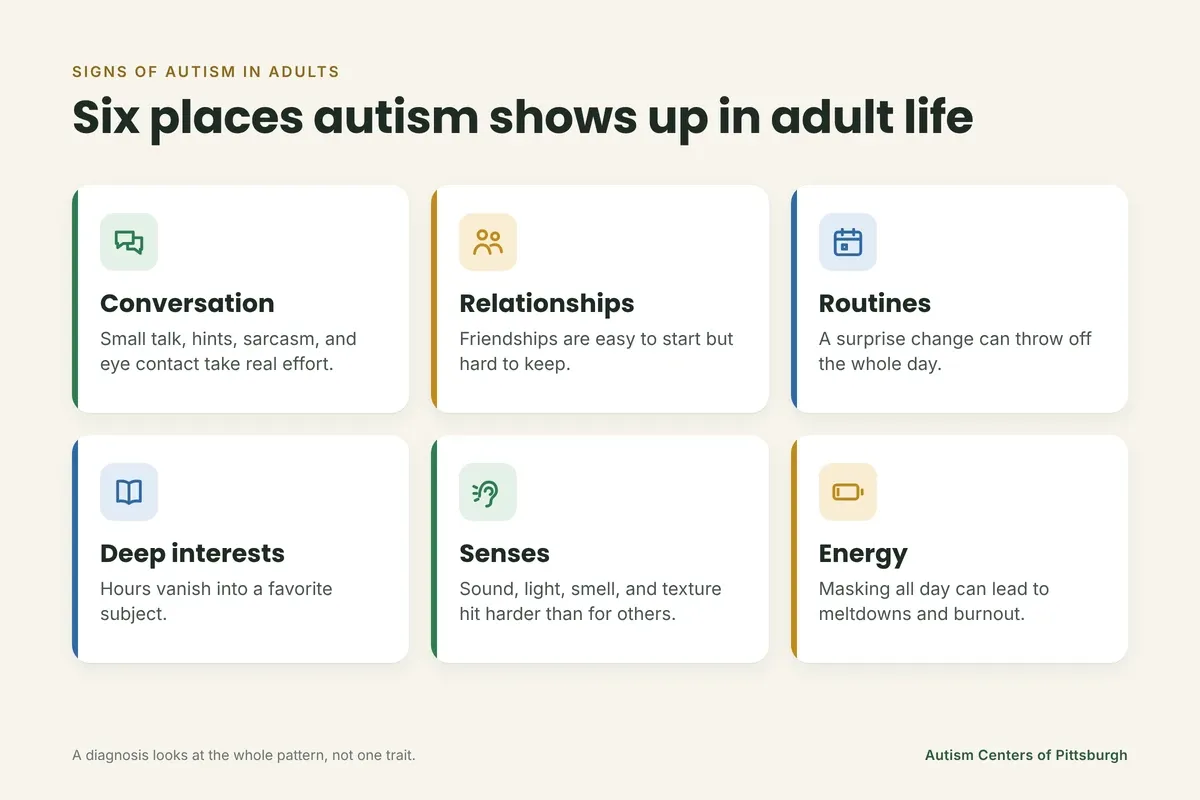
Conversation and Social Communication
• Small talk feels pointless or exhausting. You'd rather talk about something real or not talk at all.
• You miss hints, sarcasm, or "between the lines" meaning, or you take things more literally than others intend.
• Conversations feel like a dance where you don't know the steps. When to jump in, when to stop, and how to change the subject. You often find out afterward you talked too long or not enough.
• You rehearse conversations before phone calls, meetings, or social gatherings and replay them afterward.
• Eye contact feels uncomfortable or forced, or you've trained yourself to do it because you were told to.
• People sometimes call you blunt, rude, or "too much" when you were just being honest.
Friendships and Relationships
Many autistic adults deeply want connection. That's a myth worth busting. The difficulty is usually in the "how," not the "want." You may discover friendships easy to start but challenging to keep, or you may have a few very close people and very little interest in a wider circle. Romantic relationships can encounter difficulties due to unspoken expectations, emotional signals, or the need for significant alone time to recharge.
Routines and Sameness
• Unexpected changes throw off your whole day, even small ones like a rescheduled meeting or a different route to work.
• You eat the same foods, wear the same kinds of clothes, or follow the same sequence every morning, and it genuinely helps.
• "Let's just wing it" makes your stomach drop.
Intense Interests
Lots of people have hobbies. Autistic interests tend to be different in their depth and pull. You may have extensive knowledge of a subject, lose track of time while immersed in it, and struggle to shift your focus when someone needs your attention. These interests can be a real strength, too. Plenty of autistic adults build entire careers on them.
Sensitivity to Physical Experiences
Many autistic adults experience sound, light, smell, texture, or touch more intensely, or sometimes less so, than others do.

• Noisy restaurants, crowded stores, or open offices leave you frazzled or wiped out.
• Tags, seams, or certain fabrics are genuinely unbearable.
• Fluorescent lights, strong perfume, or certain food textures are hard to tolerate.
• You may seek certain sensations, like deep pressure, a weighted blanket, or the same song on repeat, because they calm you.
Repetitive Movements (Stimming)
"Stimming" is short for self-stimulatory behavior: repetitive movements or sounds that help regulate the nervous system. In adults, it's often subtle and socially "acceptable." Leg bouncing, pen clicking, hair twirling, rubbing your fingers together, pacing while you think, or repeating a phrase in your head. Many adults have spent years suppressing more noticeable stims because someone told them to stop.
Emotions, Meltdowns, and Burnout
• Intense emotions can build up and overflow suddenly, particularly after a long day of maintaining composure. That's sometimes called a meltdown. Others shut down and go quiet or numb.
• It can be challenging to name what you're feeling in the moment. You may only realize later that a situation was stressful.
• You hit periods of deep exhaustion, sometimes called autistic burnout, where even basic tasks feel like too much.
If burnout has ever slid into hopelessness, please don't sit with that alone. Call or text 988, the Suicide and Crisis Lifeline, or reach out to your doctor.
How These Signs Show Up in Everyday Life
|
Area of life |
What it can look like |
|
At work |
Thrives on clear instructions and struggles with vague
ones; drained by meetings and office noise; very strong in one area; misreads
office politics |
|
At home |
Needs long stretches of alone time to recover; strong
routines around meals or bedtime; frustration when plans change |
|
With friends |
A few deep friendships rather than many; prefers
one-on-one; leaves social events early or needs days to recover |
|
In relationships |
Partner says you "don't get the hint"; honesty
lands as harsh; trouble expressing feelings in the moment. |
|
In your body |
Overwhelmed by sound, light, or texture; subtle repetitive
movements; picky about food or clothing for sensory reasons |
How Can I Tell If I'm Autistic as an Adult?
You can't diagnose yourself. But you can do some honest homework that makes an evaluation far more useful. Here are the questions I'd want you to sit with:
1. Was this always there? Autism does not suddenly manifest at the age of 35. Think back. Were you the kid who lined things up, read the encyclopedia for fun, hated birthday parties, or played alone a lot? What did teachers say on report cards?
2. Is it a pattern or one thing? Feeling anxious at parties, on its own, isn't autism. Feeling anxious at parties plus lifelong trouble with small talk, strong routines, sensory sensitivities, and a few very intense interests? That's a pattern worth looking at.
3. How much effort does "normal" take you? Many autistic adults describe social life as something they perform rather than something that comes naturally. If you go home and collapse after acting "fine" all day, that's important information.
4. What happens when you can't control your environment? Notice your reaction to surprise changes, crowded spaces, or loud environments.
5. What do the people closest to you notice? A parent, sibling, or longtime partner often sees things you can't.
Grab a notebook and jot down examples as they come to you. Specific stories ("I cried every time I went to the mall as a kid") are far more beneficial to an evaluator than general feelings.
What Does Level 1 ("High-Functioning") Autism Look Like in Adults?
You'll hear the phrase "high-functioning autism" a lot. It isn't an official diagnosis, and many autistic adults dislike it because it hides how challenging daily life can actually be. Clinicians use "levels" instead, based on how much support a person needs.
|
Level |
What it means |
How it can look in an
adult |
|
Level 1: Requiring support |
Noticeable differences that cause real challenges without
support |
Holds a job and relationships, but social life takes
enormous effort; struggles with change, planning, and sensory overload; often
undiagnosed for years |
|
Level 2: Requiring substantial support |
Differences obvious to others even with support |
Limited social interaction; distress with change is clearly
visible; repetitive behaviors interfere with daily life. |
|
Level 3: Requiring very substantial support |
Significant challenges across most areas of life |
Very limited speech or social engagement; needs help with
many daily tasks |
Most adults diagnosed later in life fall into Level 1, which used to be called Asperger's syndrome before the diagnostic manual combined everything under autism spectrum disorder. Level 1 autism in adults often looks like a capable, sometimes high-achieving person who is privately exhausted. They may be outstanding at their job and still feel lost at the office holiday party. They may be the "rock" for their family and still need an hour alone in a dark room afterward.
“Mild" on paper doesn't mean mild in real life. Level 1 autistic adults often carry a heavy load that nobody else sees.
Masking: Why So Many Adults Fly Under the Radar
If I had to pick one word that explains why so many adults get to 40 without a diagnosis, it's masking.
Masking (researchers also call it camouflaging) is what happens when an autistic person learns to hide or compensate for their natural way of being to fit in. It can look like:
• Copying other people's facial expressions, gestures, or phrases
• Forcing eye contact and counting how long to hold it
• Preparing scripts and stock answers for common conversations
• Laughing when others laugh, even when you didn't catch the joke
• Suppressing stims, like holding your hands still under the table
• Studying people like a subject in school so you can predict what they want
Here's the catch. Masking works well enough to fool teachers, coworkers, and sometimes even doctors. But it's costly. In a well-known 2017 study at the University of Cambridge, autistic adults described camouflaging as physically and mentally exhausting, and several said they'd lost track of who they really were underneath it. A 2021 follow-up study in Molecular Autism found that camouflaging was a risk factor for anxiety and depression in autistic adults, regardless of gender.
So, when a grown adult tells me, "I'm fine at work, but I fall apart the minute I get home," I take that seriously. That's often the sound of a mask coming off.
Signs of Autism in Adult Women, and Why They're So Often Missed
For decades, autism was thought of as mostly a "boy thing." Recent research has challenged that notion.
A massive 2026 study published in The BMJ followed about 2.7 million people born in Sweden. Boys were diagnosed earlier in childhood. But girls caught up through adolescence, and by about age 20, the male-to-female ratio was close to 1:1. In other words, girls and women weren't less likely to be autistic. They were just recognized later.
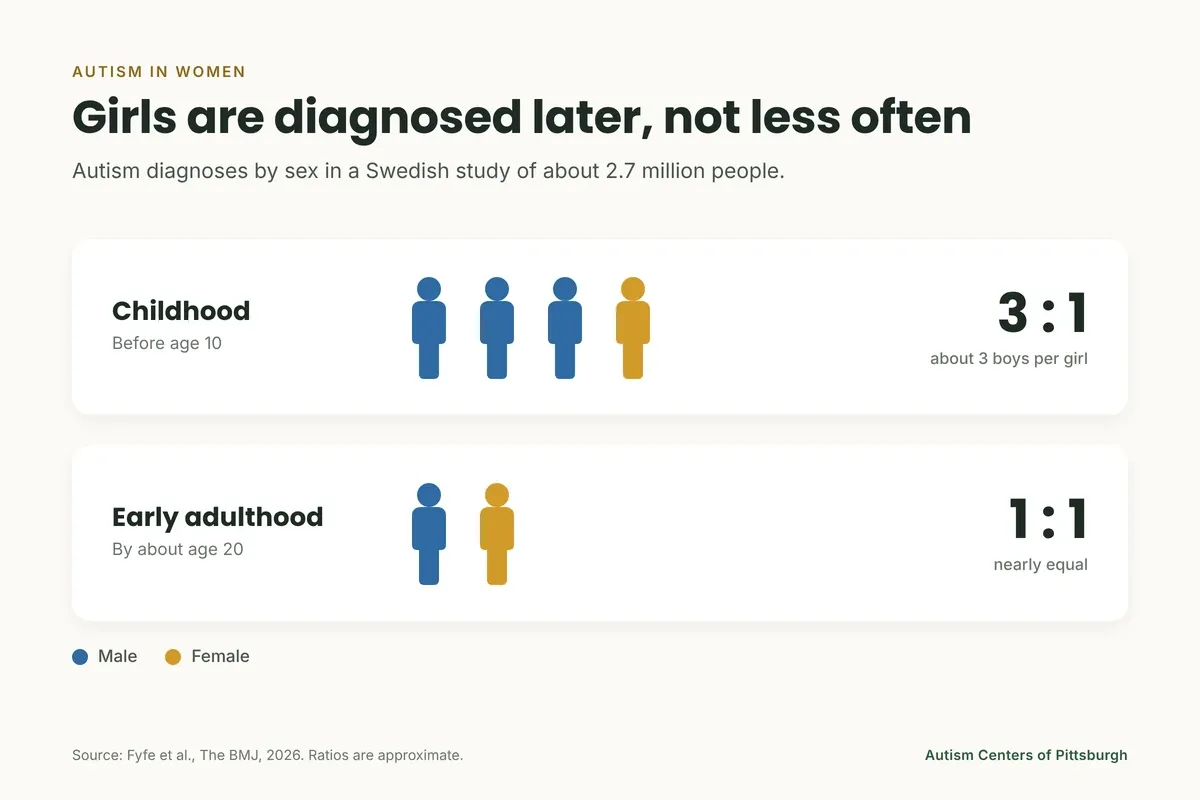
We see a similar trend here in the U.S. A 2024 study from the University of North Carolina's TEACCH Autism Program looked at more than 10,000 diagnoses across two decades. The ratio of males to females fell from more than 5 to 1 in the early 2000s to just over 3 to 1 by 2021. But females, especially those without intellectual disabilities, were still diagnosed later, often in adolescence or adulthood. And a 2024 Kaiser Permanente-led study in JAMA Network Open found autism diagnoses rose faster among adult women than adult men from 2011 to 2022.
So why are the signs of autism in adult women so often missed? A few reasons I see over and over:
• Women and girls tend to mask more, often because they're taught early to be agreeable and socially smooth.
• Their interests may look "typical." An intense passion for horses, a favorite band, psychology, or a book series doesn't raise flags the way train schedules might.
• They're often quiet rather than disruptive. A girl who's overwhelmed may withdraw instead of acting out, so nobody refers her.
• Anxiety, depression, or eating difficulties get diagnosed first. The autism underneath goes unnoticed.
• They're often deeply empathic. That collides with the old (wrong) stereotype that autistic people don't care about others.
If you're a woman reading this and feeling an uncomfortable sense of recognition, please know that's common. Many of the women I evaluate say some version of, "I thought I was just bad at being a person." You're not. You may just be wired differently.
Signs of Undiagnosed Autism That People Often Mistake for Something Else
Many adults come to me carrying several labels already. Sometimes those labels are accurate. Occasionally they're only part of the story. Here are seven signs of undiagnosed autism that are often misattributed to other conditions:
1. "I'm just an introvert." Introverts recharge alone. Autistic adults often recharge alone and find social rules confusing, not just tiring.
2. "I have social anxiety." Anxiety can absolutely be part of it. But if the worry stems from misunderstanding the unwritten rules, rather than fear of judgment alone, autism may be in the mix.
3. "I'm a perfectionist." Black-and-white thinking and a strong need for things to be "right" can be autistic traits.
4. "I'm burned out." Recurring burnout, especially after long stretches of masking, is a common thread in late-diagnosed adults.
5. "I'm a picky eater." Sometimes it's preference. Sometimes it's sensory, about texture, smell, or how foods are mixed.
6. "I'm just blunt." Directness that keeps getting you in trouble may be a communication difference, not a personality flaw.
7. "I'm moody" or "I overreact." Emotional overload after sensory or social strain can look like mood problems from the outside.
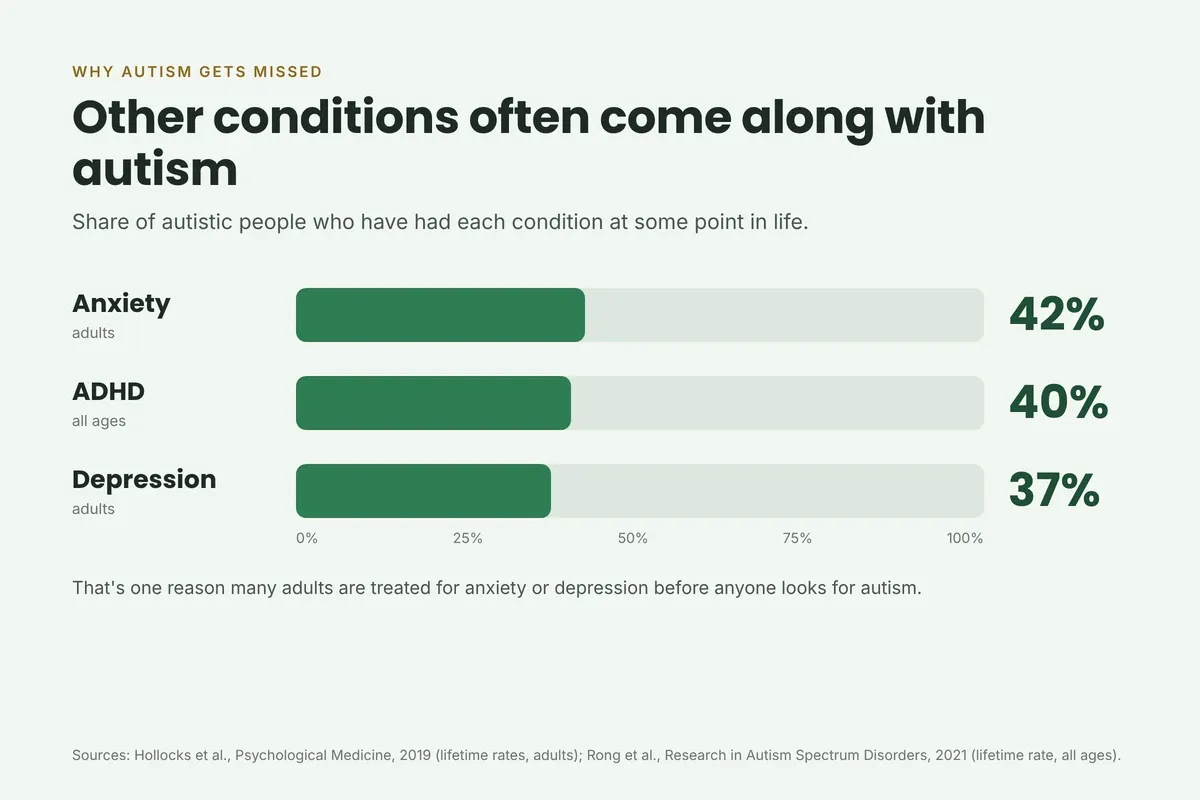
The research backs up why this happens. A 2019 review of 35 studies in Psychological Medicine found that about 27% of autistic adults currently had an anxiety disorder (42% over their lifetime), and about 23% had depression (37% over their lifetime). Those conditions are real, and they deserve treatment. They may not provide a complete understanding.
Is It Autism, ADHD, Social Anxiety, or OCD?
Distinguishing among these conditions is one of the most challenging parts of my job. Their features can overlap, and the conditions can occur together—two reasons I caution people against self-diagnosing. In fact, a 2021 analysis of 63 studies found that roughly 40% of autistic people also have ADHD at some point in their lives.
Here's a rough guide to how they tend to differ:
|
Condition |
Core issue |
How it can look like
autism |
Key difference |
|
Autism |
Social communication differences, plus repetitive
behaviors, routines, or sensory differences |
The baseline for comparison |
Traits present since early childhood; social rules feel
confusing, not just stressful |
|
ADHD |
Attention, impulse control, and activity level |
Interrupting, missing social cues, intense focus on
interests |
Social trouble comes from distraction or impulsivity, not
from not understanding the rules. |
|
Social anxiety |
Fear of judgment or embarrassment |
Avoiding events, rehearsing conversations |
Usually understands social cues well; fear, not confusion,
drives avoidance. |
|
OCD |
Unwanted intrusive thoughts and rituals to relieve them |
Rigid routines, repetitive behaviors |
Rituals feel distressing and unwanted; autistic routines
usually feel calming or satisfying. |
A careful evaluation untangles all of these issues. It's not about slapping on the most labels. It's about getting the right ones, because the correct diagnosis leads to getting the right help.
What the Research Actually Shows (and Why So Many Adults Are Diagnosed Late)
Let's look at the numbers for a minute, because they help explain why you may be reading this article right now.
There are many autistic adults. A CDC study published in 2020 estimated that about 2.2% of U.S. adults, roughly 5.4 million people, were autistic, based on 2017 data. That's still the most-cited U.S. estimate, and it includes many people who were never formally diagnosed.
More adults are getting diagnosed than ever. The 2024 JAMA Network Open study I mentioned looked at health records covering up to 12 million people. The biggest jump in diagnosis rates was among adults ages 26 to 34, about 450% over 11 years. Better awareness, less stigma, and better training for clinicians all likely play a role.
Late-diagnosed autism may have its own genetic and developmental profile. This is one of the most intriguing findings of the past few years. A 2025 study in Nature, drawing on several large birth cohorts and genetic datasets, found two partly separate genetic profiles in autism. One was linked to earlier diagnosis and social and communication differences in early childhood. The other was linked to later diagnosis, to difficulties that grew during adolescence, and to stronger genetic overlap with ADHD and mental health conditions like anxiety and depression.
That helps explain something I see all the time. Many late-diagnosed adults were treated for anxiety or depression long before anyone mentioned autism. It isn't necessarily that someone missed something obvious. Often, the picture genuinely looked different, and the clearer signs didn't emerge until the teenage years.
And the experts are still debating what it all means. In August 2026, Professor Uta Frith of University College London, one of the researchers who helped define autism's cognitive profile, published an editorial in Psychological Medicine arguing that the spectrum may have become too broad. She suggested that late-diagnosed autism might deserve to be considered separately from early-diagnosed autism. That's an open question, not a settled one, and plenty of researchers and autistic adults disagree with her.
So, what does that mean for you? Two things. First, a late diagnosis is common, and it doesn't mean you're "less autistic" or that you're making it up. Second, adult evaluations need to be careful and thorough, because the overlap with other conditions is real. That's precisely why we take our time.
Why an Online Quiz Isn't a Diagnosis
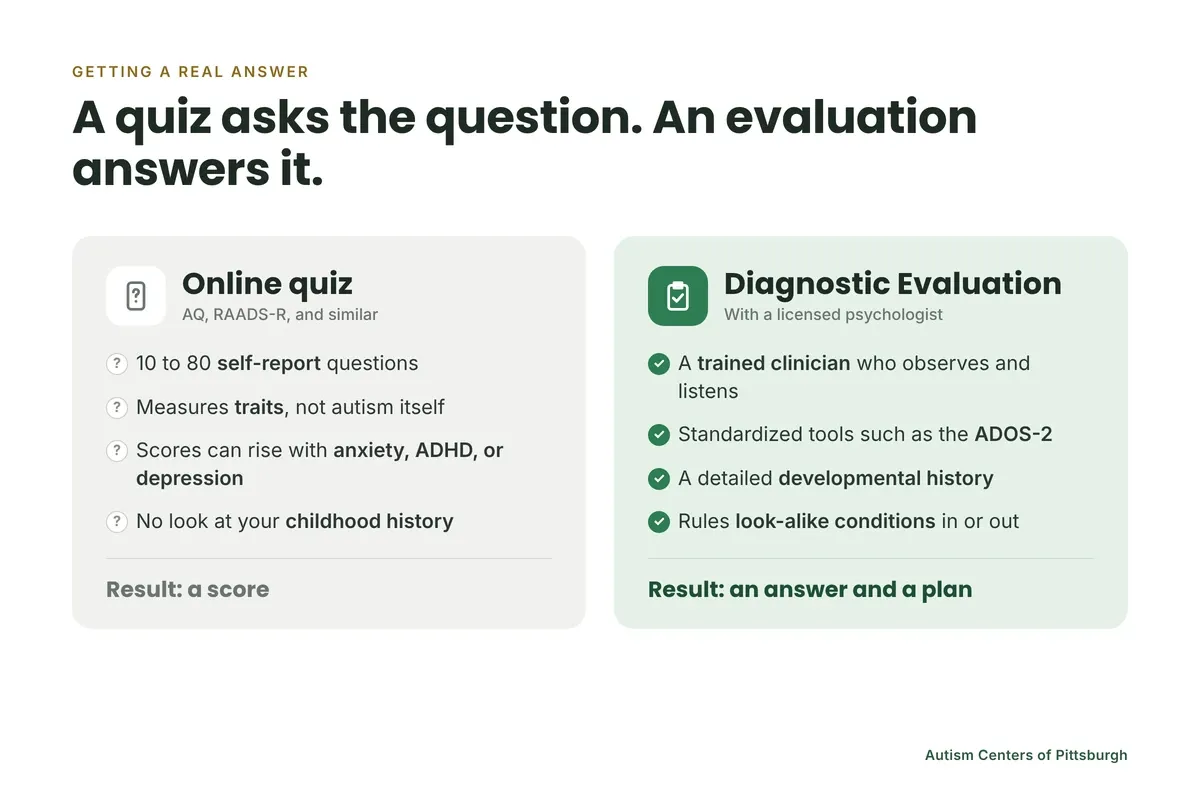
I get it. Online autism tests are free, fast, and available at 2 a.m. when the question won't leave you alone. Tools like the Autism Spectrum Quotient (AQ) or RAADS-R can be a reasonable starting point for reflection.
But here's the problem. These questionnaires measure traits, not autism. And many conditions, including anxiety, ADHD, depression, and trauma, can push those scores up.
A 2016 study in Psychological Medicine looked at 476 adults referred to a specialist autism service in England. The AQ didn't significantly predict who actually received an autism diagnosis. It flagged many people who were not autistic and missed some who were.
That's not a knock on you for taking one. It's just a reminder that a score on a website is a question, not an answer. A diagnosis takes a trained clinician, a careful history, direct observation, and a look at what else could explain what you're experiencing.
How to Get an Autism Diagnosis as an Adult
This is where a lot of people get stuck. Where do you even go? Many autism specialists only see children, and many adult mental health providers don't evaluate for autism. Here's how to move forward.
1. Find a practice that evaluates adults. Ask directly, "Do you perform autism evaluations for adults?" At Autism Centers of Pittsburgh, we do, for adults 18 and older, with no upper age limit.
2. Check your insurance. At ACP, insurance covers adult autism evaluations in 99% of cases, and we accept nearly all carriers. You can learn more on our insurance page.
3. Ask about the wait. At many providers, adults wait 6 to 12 months for an autism evaluation. Our average wait is 2 to 3 months.
4. Gather your history. More on that below.
5. Schedule the evaluation. You can start the process on our Get Help Now page.
A quick word on terms. People search for an "adult autism test," and that's fine. But autism isn't diagnosed with a single test, a blood draw, or a brain scan. The official name for what we do is called a diagnostic evaluation: a structured assessment that uses several standardized tools, interviews, and clinical observation to reach an answer.
What to Bring to an Adult Autism Evaluation
Childhood history is a crucial part of an adult evaluation, so any information that helps us understand your younger self is invaluable:
• Old report cards or teacher comments. "Bright but doesn't participate" or "prefers to work alone" tells us a lot.
If you have them, baby books, home videos, or family photos can help.Baby books, home videos, or family photos, if you have them.
• A parent, older sibling, or longtime family member who can share what you were like as a young child, if that's possible for you.
• Your notes. The examples you jotted down from the self-reflection questions above.
• A list of prior diagnoses and medications, plus any past psychological testing.
Don't worry if you don't have all of this. Many adults don't have living parents or old records. We work with what you have.
What Happens During a Diagnostic Evaluation
Every evaluation is tailored to the person, but an adult autism diagnostic evaluation at ACP draws on well-established, research-based tools. Depending on your situation, these may include the ADOS-2 (Autism Diagnostic Observation Schedule, a structured observation of social communication), the Autism Diagnostic Interview (a detailed developmental history), the Social Responsiveness Scale, and the Gilliam Autism Rating Scale. If anxiety, depression, or attention issues are present, we may also employ tools such as the Beck scales, the Wechsler intelligence scales, or a Continuous Performance Test to differentiate between autism and other conditions.
We also speak with you. A lot. The questions will cover your childhood, your work, your relationships, your senses, your routines, and what brought you in. The aim is not to expose your flaws. It's to understand you.

Our practice is led by me, a psychologist, and Dr. Robert Lowenstein, M.D., a psychiatrist. Having a psychologist and a psychiatrist on one team, under one roof, means we can look at the whole person, not just a checklist. You can read more about our adult autism evaluations here.
Is It Worth Getting Diagnosed as an Adult?
This is a fair question, and I'd rather give you an honest answer than a sales pitch.
For many adults, a diagnosis is a turning point. Here's what people tell me they gained from it:
• An explanation. "I finally understand why life has felt so hard." For many, that alone is a huge relief.
• Self-compassion. Decades of "What's wrong with me?" can become "Oh, this is how my brain works."
• Better treatment. If you've been treated for anxiety or depression for years without much progress, knowing about autism can change the approach.
• Workplace and school accommodations. A documented diagnosis can support requests for things like a quieter workspace, written instructions, or flexibility around meetings.
• Understanding from the people you love. Partners and family members often relate to you differently once they understand what's going on.
• Community. Many adults find real comfort in connecting with other autistic people.
There are also reasons some people hesitate. Some worry about stigma, about how employers might react, or about what the label will mean to their family. Those are real concerns. A diagnosis is private medical information, and you decide who hears about it. Some people choose not to share it at work. Others share it only with a partner or a counselor.
And some adults decide they don't need a formal diagnosis. That's their decision to make. An evaluation can give you clarity that a quiz can't if you're stuck in a cycle of burnout or tired of not knowing.
What Happens After an Adult Autism Diagnosis?
First, give yourself a little time. Many adults feel a mix of emotions after a diagnosis: relief, grief for the younger self who didn't get help, anger, validation, or all of the above in one afternoon. That's normal.
Then, think about next steps:
• Learn about autism from reliable sources, including books and talks by autistic adults themselves.
• Revisit your other treatment. If you are working with a therapist or prescriber for anxiety or depression, please share your results. It may shift what they focus on. Never change a medication without speaking with your doctor first.
• Find a therapist who understands adult autism. Therapy can help with anxiety, burnout, relationships, and building routines that work with your brain instead of against it.
• Adjust your environment. Consider using noise-canceling headphones, softer lighting, a predictable schedule, and built-in recovery time after social events. Small changes can make a big difference.
• Consider workplace accommodations if and when it feels right to you.
• Find your people. Online or local groups for autistic adults can provide essential support.
Most of all, a diagnosis doesn't change who you are. You're the same person you were the day before. You just have a clear roadmap now.
A Quick Word for Spouses and Family Members
Maybe you're not reading this for yourself. Maybe you're reading it because you've watched your husband, wife, adult son, or adult daughter struggle for years, and something in this list clicked.
If so, here's my advice: lead with curiosity, not a diagnosis. Saying "I read something that reminded me of you, and I wondered if it might fit" lands a lot softer than "I think you're autistic." Share the article. Offer to help gather childhood information or to come along to the evaluation if they want you there. And let them set the pace. Adults have every right to decide whether to pursue an evaluation for themselves.

What You Can Do Starting Today
1. Write down your examples. Use the self-reflection questions above and jot down specific stories, past and present.
2. Talk with someone who knew you as a child, if you can. Ask what you were like before age 5.
3. Dig up old records. Report cards, school evaluations, or earlier psychological testing.
4. Pay attention to your energy. Notice which situations drain you and which restore you. That pattern is useful information.
5. Make one small sensory change. Try headphones in a noisy space or dimmer lights at home and see if it helps.
6. Please review your insurance and contact us for an evaluation. You don't have to be certain to ask the question. That's what the evaluation is for.
You're Not Broken. You're Wired Differently, and That Can Be Understood.
If you've read this far, it's likely that some of it resonated with you. Maybe it brought relief. Maybe it stirred up many old memories. Either way, I want you to hear this: whatever the answer turns out to be, you deserve to understand yourself.
For many adults, an evaluation is the first time anyone has considered the entire picture rather than focusing on individual symptoms. Occasionally the answer is autism. Occasionally it's something else, like ADHD or anxiety, and that's valuable to know, too. Either way, you walk out with clarity and a plan.
You don't need to be certain before you call. You just need to be curious. Take that next step when you're ready and know there's a team here that's eager to walk through it with you.
God bless you and your family.
— Dr. John Carosso, Psy.D.

Ready to Take the Next Step?
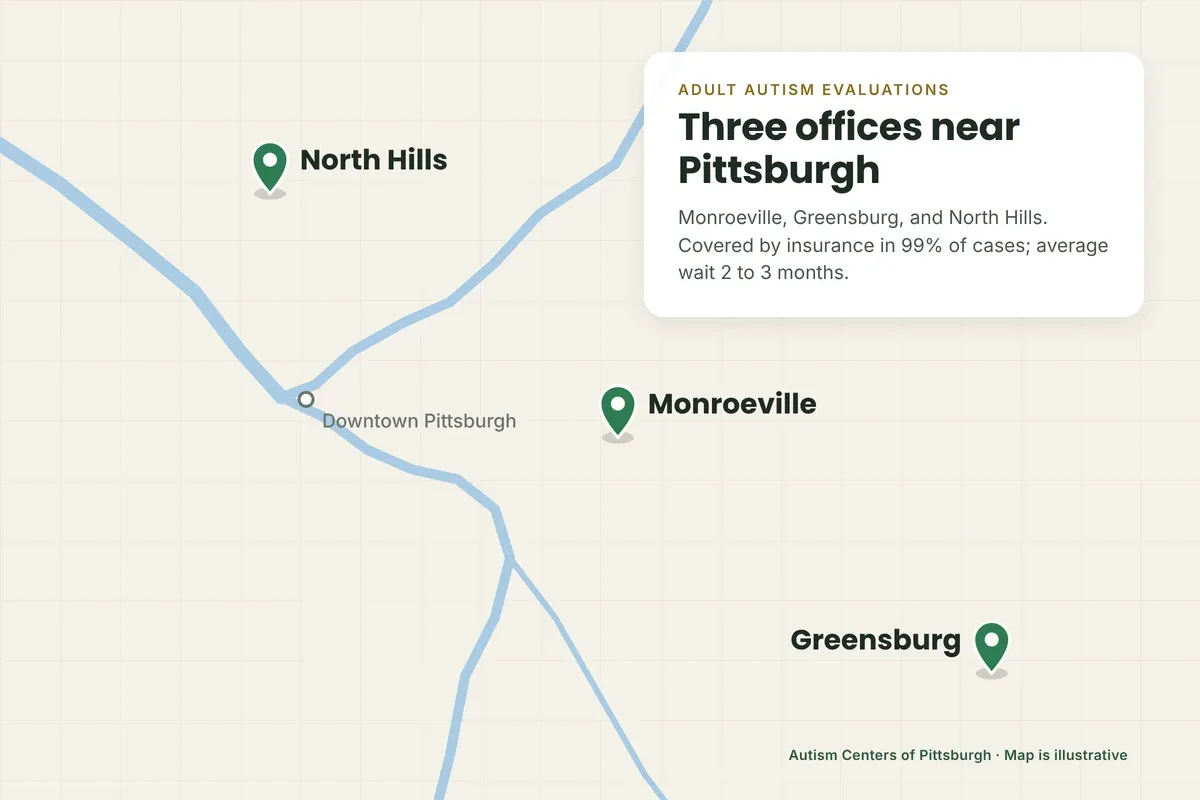
Autism Centers of Pittsburgh provides autism evaluations for adults 18 and older, as well as for children, at our offices in Monroeville, Greensburg, and North Hills. In 99% of cases, insurance covers evaluations, and our average wait time is 2 to 3 months.
• Call: (724) 733-5757
• Email: hello@acpitt.com
• Visit: acpitt.com
• Get started: Request an adult evaluation
Frequently Asked Questions
Can you be autistic and not know it until adulthood?
Yes, and it's very common. Many adults learned to mask their traits, had interests that seemed typical, or were treated for anxiety or depression first. Autism is present from childhood, but the signs often aren't recognized until adult life gets demanding enough that the coping strategies stop working.
What are the 12 signs of autism in adults?
There's no official list of 12. The most common signs of autism in adults include difficulty with small talk and social cues, taking things literally, discomfort with eye contact, a strong need for routine, distress with change, intense interests, sensory sensitivities, subtle repetitive movements, trouble identifying emotions, meltdowns or shutdowns, difficulty keeping friendships, and exhaustion after social situations. A diagnosis depends on the overall pattern, not a count.
What does mild autism look like in adults?
What people call "mild" autism is usually Level 1 autism. It often looks like a capable adult who works hard to appear socially "normal," struggles with change and sensory overload, and feels exhausted behind the scenes. It seems mild on paper but is often harsh in daily life.
Can a woman be diagnosed with autism later in life?
Absolutely. Recent research shows women are often diagnosed years later than men, largely because they mask more and their traits look less stereotypical. A large 2026 Swedish study found diagnoses were nearly equal between the sexes by about age 20.
Is there an autism test for adults?
There's no single test, blood draw, or brain scan. Autism is diagnosed through a diagnostic evaluation, which combines standardized tools like the ADOS-2 with a detailed developmental history and clinical observation. Online quizzes can prompt reflection, but they can't diagnose.
Can autism be mistaken for ADHD or anxiety?
Yes, and they also frequently occur together. About 40% of autistic people also have ADHD, and anxiety and depression are much more common in autistic adults than in the general population. A thorough evaluation sorts out what's driving what.
Do I need a referral for an adult autism evaluation?
It depends on your insurance plan. Some plans require one, and many don't. Our team can help you figure out what your plan needs when you reach out.
How long does it take to get an adult autism evaluation?
At many providers, the wait is 6 to 12 months. At Autism Centers of Pittsburgh, the average wait is 2 to 3 months at our Monroeville, Greensburg, and North Hills offices.
Sources
• Autism Spectrum Disorder, National Institute of Mental Health, 2024
• National and State Estimates of Adults with Autism Spectrum Disorder (Dietz et al.), Journal of Autism and Developmental Disorders / CDC, 2020
• More Women, Young Adults Being Diagnosed with Autism (Grosvenor et al., JAMA Network Open), Kaiser Permanente Division of Research, 2024
• Time Trends in the Male to Female Ratio for Autism Incidence (Fyfe et al.), The BMJ, 2026
• Are the Diagnostic Rates of Autistic Females Increasing? An Examination of State-Wide Trends (Harrop et al., Journal of Child Psychology and Psychiatry), UNC Frank Porter Graham Child Development Institute, 2024
• Polygenic and Developmental Profiles of Autism Differ by Age at Diagnosis (Zhang et al.), Nature, 2025
• Has Autism Become Too Broad to Be Useful? (Frith, Psychological Medicine), University College London, 2026
• Anxiety and Depression in Adults with Autism Spectrum Disorder: A Systematic Review and Meta-Analysis (Hollocks et al.), Psychological Medicine, 2019
• Prevalence of Attention-Deficit/Hyperactivity Disorder in Individuals with Autism Spectrum Disorder: A Meta-Analysis (Rong et al.), Research in Autism Spectrum Disorders, 2021
• "Putting on My Best Normal": Social Camouflaging in Adults with Autism Spectrum Conditions (Hull et al.), Journal of Autism and Developmental Disorders, 2017
• Is Social Camouflaging Associated with Anxiety and Depression in Autistic Adults? (Hull et al.), Molecular Autism, 2021
• Predicting the Diagnosis of Autism in Adults Using the Autism-Spectrum Quotient (AQ) Questionnaire (Ashwood et al.), Psychological Medicine, 2016
Looking for Answers?
Dr. Carosso evaluates children ages 2–17 and adults of any age at our Monroeville, Greensburg and North Hills offices. The average wait is 2–3 months, and insurance covers the evaluation in about 99% of cases.
Request an EvaluationGet Dr. Carosso’s latest articles by email
Trusted, practical guidance for your family, delivered straight to your inbox as soon as Dr. Carosso publishes new content.