Potty Training for Autism: A Step-by-Step Guide for Parents
Article at a Glance
- Most children with autism can be potty trained. According to the American Academy of Pediatrics, most children with autism, developmental delays, or intellectual disabilities can learn to use the toilet. It simply takes longer, sometimes a few months and sometimes a year or more.
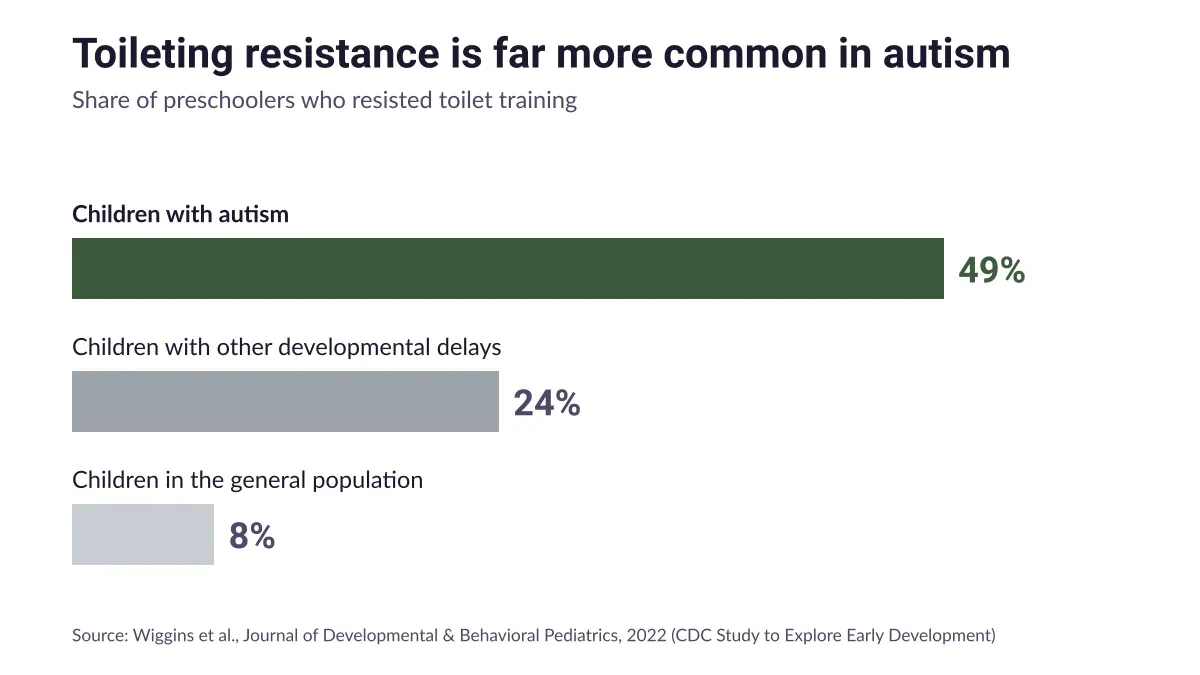
- Toileting resistance is far more common in autism. A CDC-funded study published in the Journal of Developmental & Behavioral Pediatrics found that about 49% of preschoolers with autism resisted toilet training, compared with 8% of children in the general population.
- The reasons are rarely "stubbornness." Body awareness, communication, sensory issues, a love of routine, and tummy troubles all play a role, and each one has a workaround.
- Readiness matters more than age. Look for skills like staying dry for an hour or two and noticing a wet diaper, not a birthday on the calendar.
- Structure is your best friend. Scheduled potty sits, a simple visual routine, and a reward that your child genuinely loves will do most of the heavy lifting.
- Constipation can derail everything. Research published in Pediatrics found that children with autism are almost four times more likely to experience constipation, so speak with your pediatrician if bathroom trips seem painful.
- ABA therapy can help. Toilet training is one of the most common goals in ABA therapy. In Pennsylvania, Act 62 requires many health plans to cover ABA for children and young adults under 21.
You bought the little potty. You've read the books, watched the videos, and stocked up on stickers. And your kiddo? He's happily sitting on the potty for exactly four seconds before wandering off to line up his cars. Then he pees on the kitchen floor ten minutes later.
Sound familiar?
Here's a scene I see in my office all the time. A parent sits down, takes a deep breath, and says, "Dr. C, I'm starting to wonder if he'll ever be potty trained." Usually they whisper it, like it's a confession. So let me say the most important thing right up front: in the vast majority of cases, the answer is yes. Your child can learn this skill. It just might take a different path and a bit more patience than many parenting books describe.
The Short Answer: Yes, Your Child Can Learn This
According to the American Academy of Pediatrics, most children with autism, a developmental delay, or an intellectual disability can be toilet trained. The AAP notes that the process can take anywhere from a few months to a year or more and that many children with special needs finish toilet training around age five or later.
Read that again: around age five or later. If your four-year-old isn't trained yet, you're on schedule. You're on a different timeline.
The goal isn't to beat the neighbor's kid to the finish line. It's independence and dignity for your child, and that's worth the wait.
Is Potty Training Harder for Children with Autism?
Real talk: yes, it usually is. And now we have numbers that back up what parents have been telling me for decades.
Researchers working with the CDC's Study to Explore Early Development looked at more than 2,000 preschool children. Toileting resistance showed up in about 49% of children with autism, about 24% of children with other developmental delays, and only 8% of children in the general population. The study, led by Dr. Lisa Wiggins and published in the Journal of Developmental & Behavioral Pediatrics, also found that constipation, delayed expressive language, and lower social motivation were tied to toileting resistance in the children with autism.
So why is it harder? It's almost never about defiance. Here are the usual suspects.
Body Awareness (Interoception)
Interoception is the sense that tells us what's going on inside our bodies, like hunger, thirst, and that "I need to go" feeling. Many children with autism have a difficult time noticing or interpreting those signals. If your child doesn't feel the urge until it's too late, no amount of reminding them to "use your words" will fix that. We have to teach the body cue, too.
Communication
Even a child who feels the urge has to tell someone or get himself to the bathroom in time. For children with limited speech, this can be a significant challenge. That's why a simple, consistent way to say "potty" (a picture card, a sign, or a device) is so important.
Sensory Sensitivities
Think about a bathroom from a sensory perspective. Echoing tile. A toilet that roars when it flushes. A cold seat. Bright lights. Strong-smelling soap. For a child with sensory sensitivities, the bathroom can feel like the most unwelcoming room in the house.
A Love of Routine
Many children with autism find comfort in sameness, and diapers have been part of the routine since birth. Giving that up is a big change.
Social Motivation
A lot of toilet training relies on social praise ("Big boy!"), but many children with autism are simply less affected by it. That doesn't mean rewards don't work. It means we need to find the one that matters to your kiddo.
Tummy Troubles
This one gets missed constantly. A meta-analysis published in Pediatrics found that children with autism are about four times more likely to have gastrointestinal symptoms overall and almost four times more likely to experience constipation. If pooping hurts, your child will avoid it. And who could blame him?
When Should You Start Potty Training a Child with Autism?
Here's the thing: readiness matters far more than age. Some children with autism are ready at three, others at six or seven. Both are normal.
Here are the readiness signs I look for. Most of them come straight from the American Academy of Pediatrics' list, and here's what they look like in real life.
|
Readiness
sign |
What
it might look like at home |
|
Stays dry for an hour or two |
You check the diaper after naptime or a car ride, and it's
dry. |
|
Notices being wet or soiled |
The child may pull at the diaper, get upset, or bring you
a clean one. |
|
Has fairly regular bowel movements |
Poops at roughly the same times each day. |
|
Shows awareness of going |
Pauses, hides, squats, or goes quiet just before peeing or
pooping. |
|
Can follow a simple direction |
The child responds to commands such as "sit
down" or "come here," even if it is through a gesture or a
picture. |
|
Can help with clothing |
They can pull their pants down and up, even with some
assistance. |
Your child doesn't need to check every box. If you see three or four of these, it's usually reasonable to begin. And before you start, speak with your pediatrician. The AAP recommends a checkup first, because constipation or loose stools can quietly sabotage the whole process.
How to Potty Train a Child with Autism, Step by Step
Bottom line: consistency beats intensity. The approach I recommend to families has four steps, and you move to the next one only when the previous step is going well.
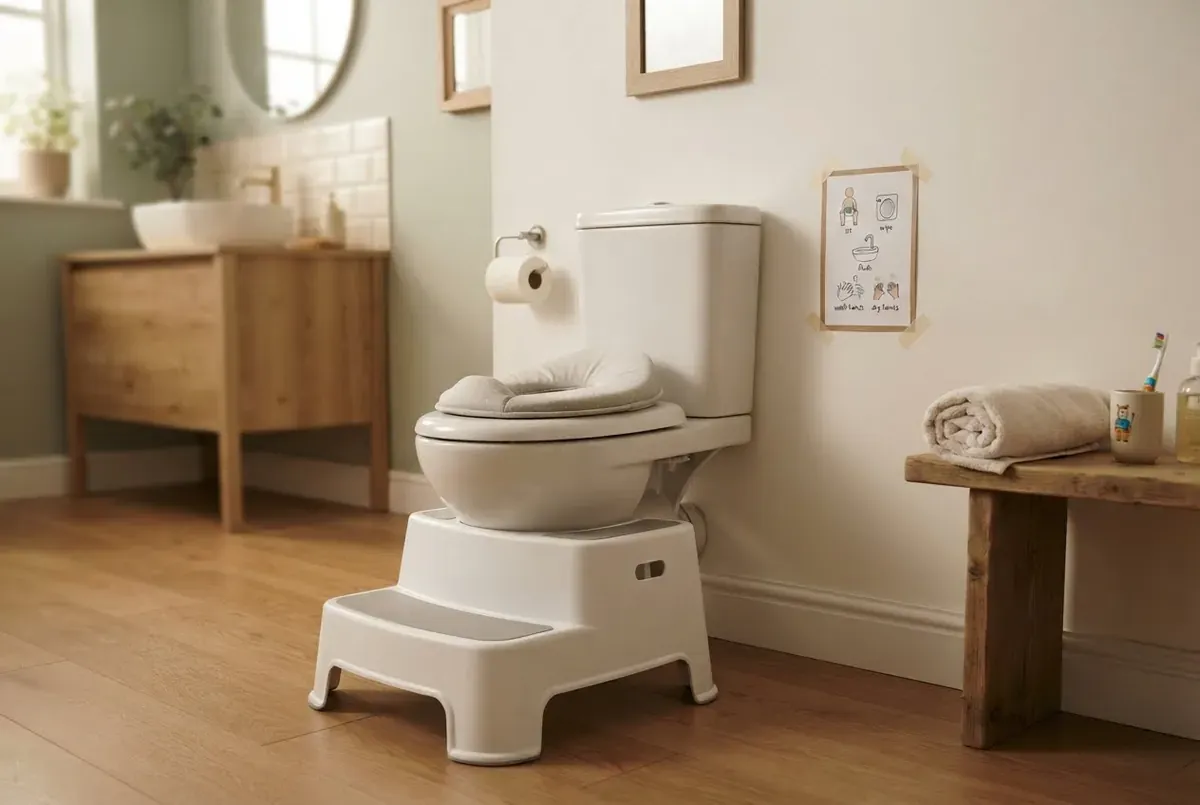
Before you begin, set the stage. Choose one word for the potty, one for pee, and one for poop, and have all adults use the same words (and the same pictures or signs, if your child uses them). Make the bathroom friendly, with a step stool so feet are planted and a padded seat insert or small potty chair if the big toilet feels scary. And pick a calm season. If you're moving, welcoming a new baby, or starting a new school, wait a few weeks.
Step 1: Keep an Elimination Record
For one week, check your child's diaper every 30 to 60 minutes and write down what you find: dry, peed, or pooped. Note meals and drinks, too. By the end of the week, you'll usually see a pattern, and that pattern tells you when to schedule potty sits.
Step 2: Goal Training
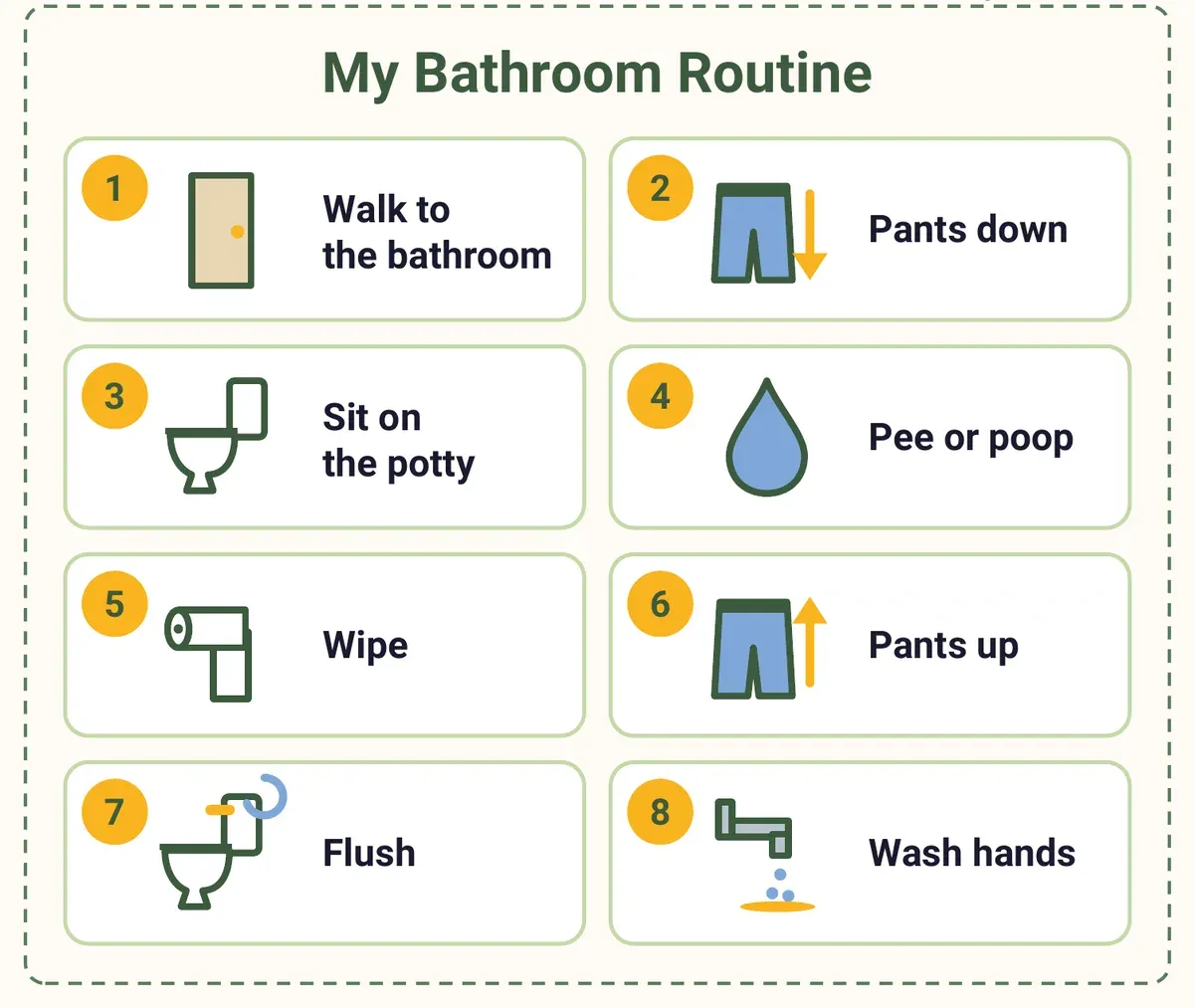
Toileting is really a chain of small skills: walk in, pants down, sit, pee, wipe, pants up, flush, and wash hands. That's a lot to learn at once. So start with one small, achievable goal, like pushing pants down and pulling them up, then add the next link. The AAP suggests making the actual peeing and pooping a priority and polishing the other steps later. Regardless, it's a step-by-step process.
Step 3: Habit Training
Now use your record to schedule regular potty sits, timed to when your child usually goes, plus right after meals and after waking. Keep each sit calm and short (the AAP suggests five to ten minutes at most), and a favorite book or song can help. The moment pee or poop lands in the potty, celebrate and hand over a reward your child truly loves. Keep that reward just for the potty, so it stays special.
Step 4: Initiation Training
This is where your child learns to notice the urge and start the trip on his own. Pause a moment before you prompt, teach a simple way to ask (a word, a sign, or a picture card), and give an extra-big reward when your child heads to the bathroom independently. Over time, fade your prompts.
Along the Way
• Switch to cotton underwear during the day. Diapers and pull-ups feel the same whether they are wet or dry. Underwear lets your child feel the difference.
• Handle accidents calmly. Keep your voice neutral, say "Pee goes in the potty," and help with cleanup. We want the potty to get the attention, not the accident.
• Practice everywhere. Use the same words, pictures, and routine at school, at Grandma's, and at the store, because children with autism often don't automatically carry a skill from one place to the next.
Want all of this in one place? Download our free parent guide, Toilet Training for Children with Autism. It walks through the four steps with a sample elimination record and ends with a printable bathroom routine.
Using Pictures, Visual Schedules, and Social Stories
Many children with autism understand what they see much better than what they hear. That's why visuals are one of the most helpful tools you have.
A visual schedule is a simple strip of pictures showing each step of the bathroom routine in order. Tape it at your child's eye level, right next to the toilet. Point to each picture as you go, and soon your child will follow it alone.
A potty chart visually displays progress, with a sticker representing each success.
A social story is a short, simple story, often with pictures, that explains what happens when we use the potty and why. It's written from the child's perspective ("When I feel like I need to pee, I go to the bathroom..."). Read it together at calm times, not just in the bathroom.
You don't need anything fancy. Photos of your bathroom and your child's potty often work better than cartoon clip art, because they're familiar. Our free toilet training guide also ends with a ready-to-print bathroom routine you can tape up today.
Sensory Challenges and Body Awareness
If your child melts down in the bathroom, refuses to sit, or panics at the flush, there's often a sensory reason behind it. Become a detective. Is it the noise? The cold seat? The feeling of falling into a big toilet? The smell?
A few common fixes:
• Noise: Delay flushing until your child has left the bathroom, or let your child wear headphones at first.
• Cold or unstable seat: Try a padded insert and a sturdy step stool so feet are flat and your child feels secure.
• Clothing: Elastic waistbands and soft, tagless underwear make the routine faster and more comfortable.
Now let's talk about body awareness. Occupational therapists like Kelly Mahler are leading a growing body of work that focuses on helping children notice internal body signals. In plain English, we're teaching your child what "I need to go" feels like.
You can help at home by naming body feelings out loud ("Your tummy is full," "You peed, and your bladder feels empty now"). Those small moments build the connection over time, and an occupational therapist can offer more targeted strategies.
Potty Training a Nonverbal Child with Autism
Here's the deal: a child doesn't need to talk to be potty trained. He needs a reliable way to communicate "I need to go" and a routine he can follow.
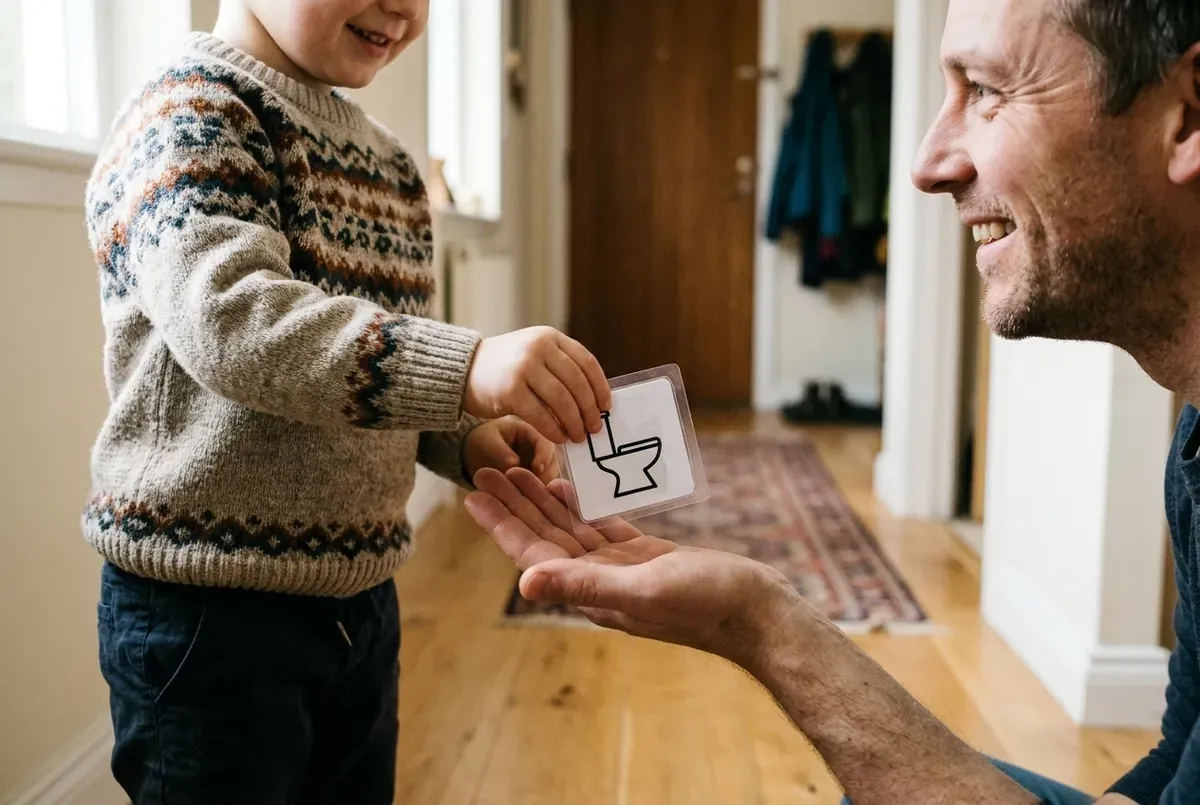
A few strategies that help nonverbal kiddos:
• Teach a "potty" request. Use a picture card, a sign, or a button on a speech device. Prompt your child to use it right before every scheduled sit, so it becomes part of the routine.
• Lean on the schedule. For many nonverbal children, scheduled sits do most of the work, especially early on. Requests often come later, once the routine is solid.
• Watch for your child's cues. Many children exhibit signs before they need to go, such as becoming quiet, hiding, squatting, or tugging at their clothes. When you spot it, calmly guide your child to the bathroom.
The AAP notes that the process gets easier once a child has some way to communicate, so building that communication is progress in itself.
What to Do About Potty Training Regression
Your child was doing great. Suddenly, accidents begin to accumulate. Take a deep breath. Regression is pretty common, and it's usually temporary.
Common triggers include:
• A change in routine, like a new school, a move, a new sibling, or a vacation
• Illness or constipation
• A scary bathroom experience, like a loud public toilet or an automatic flush
When regression occurs, return to the fundamentals. Bring back scheduled sits, the visual routine, and the special reward for a while. Stay calm and matter-of-fact about accidents. Once things settle, your child will usually return to where he was, often faster than the first time around.
If regression comes with pain, blood in the stool, or a sudden loss of other skills, call your pediatrician. Those deserve a closer look.
Does the 3-Day Potty Training Method Work for Autism?
You've probably seen programs promising potty training in three days. They're popular for a reason, and they're built on real science.
Most of these programs trace back to the work of Nathan Azrin and Richard Foxx, who published a rapid toilet training method in 1971. Their approach combined extra fluids (so there are more chances to practice), frequent scheduled sits, and immediate rewards for success. Researchers have since adapted it for children with autism, usually dropping the original's punishment-based steps. A systematic review published by the National Association of Special Education Teachers found that modified versions of this intensive approach helped many children with autism and other developmental disabilities increase their success on the toilet.
So, can an intensive approach work? For many children, yes. But here's my honest take: the "three days" part is a marketing hook. Some kiddos make big gains in a long weekend, and many others need several weeks. Intensive methods also ask many parents, including a cleared schedule and a strong stomach for accidents.
If you try one, speak with your pediatrician first, especially before increasing fluids. If it doesn't click within three days, don't consider it a failure. Keep the routine going.
How ABA Therapy Helps with Toilet Training
ABA, or Applied Behavior Analysis, is a therapy that teaches skills by breaking them into small steps and rewarding progress. In plain words, it's a structured, data-driven way of teaching the exact things this article describes.
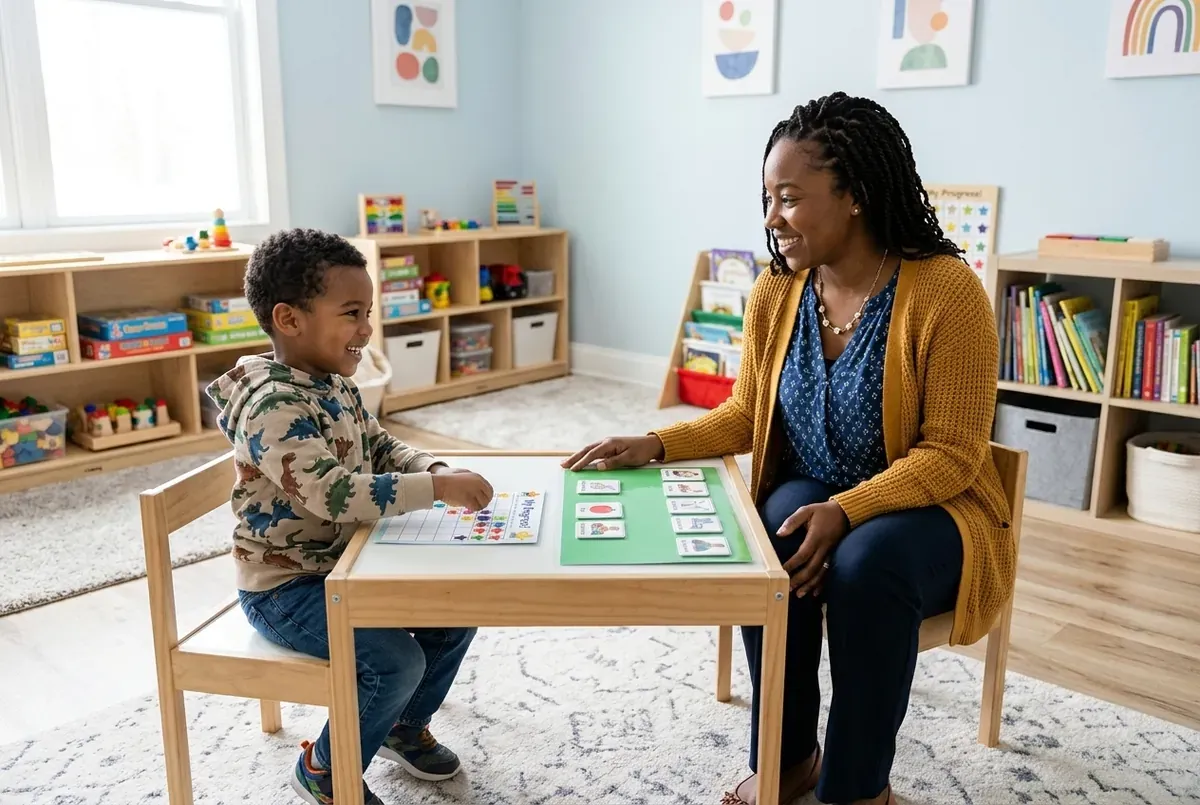
Toilet training is one of the most common goals we work on in ABA therapy. At our center-based ABA program in Monroeville, our therapists help children with:
• Tracking patterns so potty sits happen at the right times
• Breaking the bathroom routine into small, teachable steps
• Teaching a reliable way to request the bathroom, including for nonverbal children
• Working through sensory challenges and fear of the toilet
• Coaching parents so the same routine continues at home
That last piece matters most. Children learn fastest when home and therapy follow the same routine.
If you'd like to learn more, our guide to what ABA therapy is and how it works is a great place to start, and our ABA therapy FAQ answers the questions parents ask us most. Here's some good news on cost. Pennsylvania's Autism Insurance Act, known as Act 62, requires many health plans to cover autism diagnosis and treatment, including ABA therapy, for children and young adults under 21. It applies to Pennsylvania-issued employer group plans, and Medical Assistance and CHIP cover eligible children too. It doesn't apply to self-funded (ERISA) employer plans or policies issued outside Pennsylvania, and deductibles, copays, and prior authorization still apply. So call your insurer and ask three questions: Is my plan fully insured or self-funded? Does Act 62 apply? What does the plan require for ABA? Our family guide to insurance for autism walks through the details, and our team is happy to help you sort it out.
Not sure whether your child has autism? That's where we start. Our child autism evaluations are covered by insurance in the vast majority of cases, and families typically wait two to three months, far shorter than the six-month to one-year waits common elsewhere.
When to Talk with Your Pediatrician
Most potty training struggles are a normal part of the process. But some signs deserve a call to your pediatrician:
• Pain when peeing or pooping
• Hard, infrequent, or very large stools, or holding stool in
• Blood in the stool or urine
• Frequent diarrhea
• Peeing much more often than usual, or sudden new accidents after being trained
• Losing skills your child already had
Constipation in particular is worth taking seriously. It makes pooping painful, and treating it often makes training go much more smoothly. Never start a laxative, supplement, or medication change without your pediatrician's guidance.
A Quick Word for Exhausted Parents
If you're exhausted, frustrated, or worried, you're not alone. Potty training is challenging for every family, and it's often harder when autism is part of the picture.
Please hear me: a slow potty training journey says nothing about your parenting or your child's future. Some of the most capable young adults I've worked with took years to master this skill. Celebrate the small wins, like sitting for a full minute or using the potty once. They add up.
And be sure to take a break every so often. A tired parent can take a weekend off from the schedule without undoing all the progress. Progress, not perfection.
Progress, Not Perfection
Potty training a child with autism is often a winding path. There will be wonderful days, tough days, and days you'll laugh about later (I promise). But with readiness, structure, the right rewards, and a whole lot of patience, most children get there.
Ready to Take the Next Step?
If you're feeling stuck, please know you don't have to navigate these challenges alone. If you need help with toilet training or suspect your child may have autism, my team and I are here for you. At Autism Centers of Pittsburgh we provide child and adult autism evaluations and center-based ABA therapy.
Please reach out. That's what we're here for.
God bless you and your family.
— Dr. John Carosso, Psy.D.

- Phone: (724) 733-5757
- Email: hello@acpitt.com
- Web: acpitt.com
- Locations: Monroeville, Greensburg, and North Hills
Get Help Now to schedule an evaluation or start ABA therapy.
Frequently Asked Questions
At what age should a child with autism be potty trained?
There's no single right age. The American Academy of Pediatrics notes that many children with special needs finish toilet training around age five or later. Focus on readiness signs, like staying dry for an hour or two and noticing a wet diaper, rather than the calendar.
Is it normal for a 5-year-old with autism not to be potty trained?
Yes, it's pretty common. Many children with autism need more time to learn toileting, especially if they have communication challenges, sensory sensitivities, or constipation. If you're concerned, speak with your pediatrician and consider asking about ABA therapy.
What if my child is afraid of the toilet?
Go slowly. Let your child sit fully clothed at first, use a small potty or padded seat, delay flushing, and reward simply sitting. A visual schedule and a social story can make the routine feel predictable and safe.
How long does potty training take for a child with autism?
It varies a lot. According to the American Academy of Pediatrics, it can take anywhere from a few months to a year or more. Consistency matters far more than speed.
Sources
• Potty Training Children with Special Needs, American Academy of Pediatrics, HealthyChildren.org
• Toileting Resistance Among Preschool-Age Children with and Without Autism Spectrum Disorder, Journal of Developmental & Behavioral Pediatrics, 2022
• Gastrointestinal Symptoms in Autism Spectrum Disorder: A Meta-analysis, Pediatrics, 2014
• Increasing Independent Toileting in Children with Autism Spectrum Disorder and Other Developmental Disabilities: A Systematic Review, National Association of Special Education Teachers
• A Highly Effective Toilet Training Program Based on Applied Behavior Analysis Principles, Autism Spectrum News
• Interoception, Toileting, and Potty Training: Understanding Inner Body Signals, Kelly Mahler, occupational therapist
• Autism Insurance Act (Act 62) Fact Sheet, Pennsylvania Department of Human Services